Intangible Heritage and the Archive Problem: A UNESCO Listing Is Not a Recording
Four women in blue and red robes stand barefoot on a wooden stage in front of a carved stone relief panel, mid-sequence in an Okinawan dance. In the bottom third of the frame, a hand rises out of the dark auditorium holding a phone, and on the phone screen the same four women appear again, about three centimetres tall, lit and rendered by a computational photography pipeline that has never seen this dance before. Two archives are being made at once. Only one of them has an institution behind it.
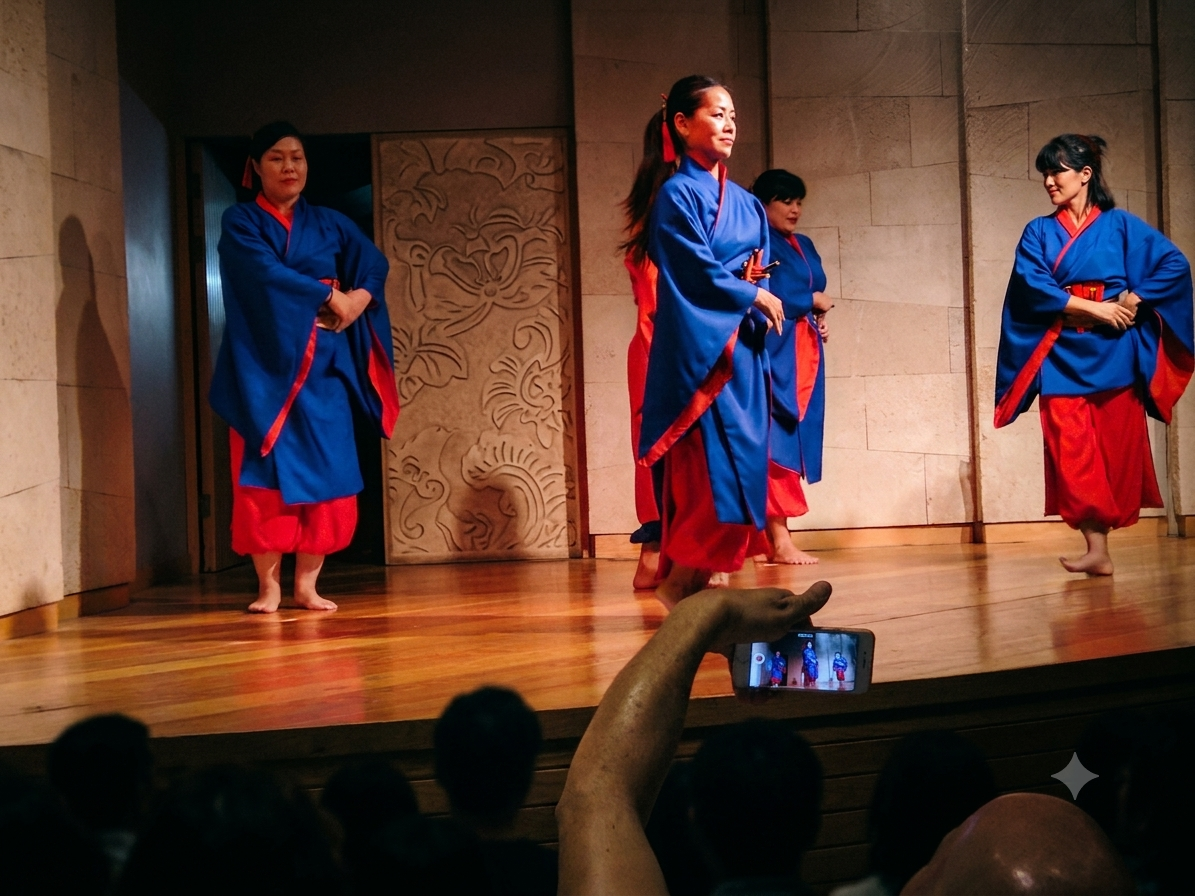
Okinawa’s traditional performing arts are among the best protected in the world on paper. Kumiodori, the musical theatre form created by Tamagusuku Chōkun around 1719 to entertain the Chinese investiture envoys to the Ryukyu Kingdom, was designated a nationally important intangible cultural property by Japan in 1972 and inscribed on the UNESCO Representative List of the Intangible Cultural Heritage of Humanity in 2010. Ryukyuan dance sits inside the same protective and institutional apparatus. There is a national theatre dedicated to the repertoire, opened in Urasoe in January 2004, with a training programme running since the following year.
And yet the most complete visual record of any given performance is likely to be sitting, uncatalogued, in the camera roll of a stranger in row eight.
What a Listing Actually Protects
The 2003 UNESCO convention on intangible heritage was written to correct something the World Heritage system could not handle. World Heritage protects things: a temple, a city wall, a landscape. Intangible heritage has no object to fence off. What is being safeguarded is a practice that exists only while someone is doing it, and that stops existing when the last person who can do it stops.
Japan had worked this out half a century earlier. The 1950 Cultural Properties Protection Law created a category for intangible properties and, with it, the system that produces holders of important intangible cultural properties, popularly called living national treasures. The unit of protection is a person. That framework fed directly into the international convention, and the convention’s safeguarding criteria reflect it: when kumiodori was inscribed, the measures cited were transmission to young performers and training for costume makers.
Read that second item again. The listing recognised that a theatrical form dies not only when the actors stop, but when nobody can make the robes.
So a listing is a commitment to keep people practising. It is not, and was never designed to be, a commitment to record anything. This is a defensible position. A form kept alive only in files is not alive.
It is also a gap, and the gap is where the media question sits.
Three Layers That Get Confused
There are three separate states and public discussion collapses them constantly.
There is the listing, which is a designation. It confers status, attracts funding, generates tourism, and creates an obligation on a state party to report on safeguarding. It preserves nothing by itself.
There is the recording, which is documentation. Scripts, notation, costume patterns, video of performances, oral history with senior practitioners. Japan’s national theatre in Okinawa does this work, collecting scripts, costumes and props both old and new, alongside its performance schedule.
There is the practice, which is transmission. A teacher standing next to a student for years, correcting weight distribution, breath, the timing of a turn, and the pronunciation of a language that fewer people speak every year. Kumiodori is performed in classical Ryukyuan, not modern Japanese. That is a language dependency inside an art form, and it is the kind of thing no video solves.
Documentation captures the output of transmission. It does not capture transmission. You cannot learn the form from the archive, which is exactly why the convention treats the archive as secondary.
The Bottleneck Is People, and Everyone Knows It
The national theatre states its own problem plainly: kumiodori lacks the absolute number of performers, and training successors is urgent. That is why the training curriculum exists, and why graduates of it formed their own company in 2008 to keep performing after the programme ended.
Around seventy pieces are in the working repertoire. The classics have been performed for three centuries. Neither of those facts guarantees the next thirty years, because the constraint is not repertoire and not money in the first instance. It is how many people are willing to spend a decade learning a form performed in a classical language, in a prefecture whose economy runs largely on tourism, military basing and services.
The supply chain problem is real too. Costume makers, sanshin builders, drum skin specialists. Each is a small trade with its own succession question, and each one failing degrades the form even if every performer stays.
Two Archives, Unequal Resources
Here is the media asymmetry. Institutions produce a small number of authoritative recordings: fixed camera, proper audio, rights cleared, catalogued, accessible to researchers on request. Call it a handful of definitive documents per year.
Audiences produce thousands of fragments. Vertical, 40 seconds, handheld, one angle, terrible audio, no metadata beyond a timestamp and a location. Most of it never leaves the phone. Some of it goes to social platforms where it reaches audiences the institution cannot buy, and where it will persist exactly as long as the platform’s business model and content policies allow.
The institutional archive is authoritative and tiny. The distributed archive is enormous, low quality, legally messy, and stored on infrastructure nobody involved controls.
Venues respond to this in one of two ways. Ban filming, which protects performer rights and the box office argument, and forfeits the distribution. Or permit it, which converts every audience member into a channel and accepts that the resulting record will be uneven and uncontrolled. Traditional arts institutions in particular tend toward the first, on grounds of dignity and rights, and then complain about young audiences not showing up.
What an Honest Archive Would Require
If the goal were an archive that could actually support reconstruction rather than just documentation, the specification is knowable.
Multiple synchronised angles, including one fixed wide that never cuts. Separate audio capture per instrument. The rehearsal room, not only the performance, because correction is where the knowledge is visible. Practitioner annotation, recorded at the time by people who can say why a movement is wrong. Motion capture for the movement vocabulary, using the same pipeline that feeds game animation and now costs a fraction of what it did a decade ago. Costume and instrument construction filmed as process, not photographed as objects.
None of that is technically hard in 2026. The obstacles are money, rights and consent, and the reasonable suspicion of practitioners that comprehensive recording is a step toward being replaced by the recording.
That last objection deserves respect rather than dismissal. But insurance is not a substitute for health. A serious archive is what you want to have if a lineage breaks, and lineages break for reasons nobody plans for: a war, a fire, a generation that chooses differently. Shuri Castle burned in 2019 and it had blueprints. The form does not.
The dancers finish, the crowd stands up, and the only complete record of that evening goes home in somebody’s pocket.