Accreditation, Rope Lines, and Shot Lists: How a Press Pack Decides What Never Gets Photographed
Nine men stand inside a rope line at the Giro d’Italia, carrying between them perhaps forty thousand euros of equipment. Numbered tabards pulled over polo shirts. Lanyards with the organizer’s logo. Two bodies each, a long zoom hanging muzzle down at the hip, a Manfrotto tripod tube slung diagonally across the back. Every one of them is looking in roughly the same direction, and none of them is looking at the woman walking past the front of the frame in a black and white dress.
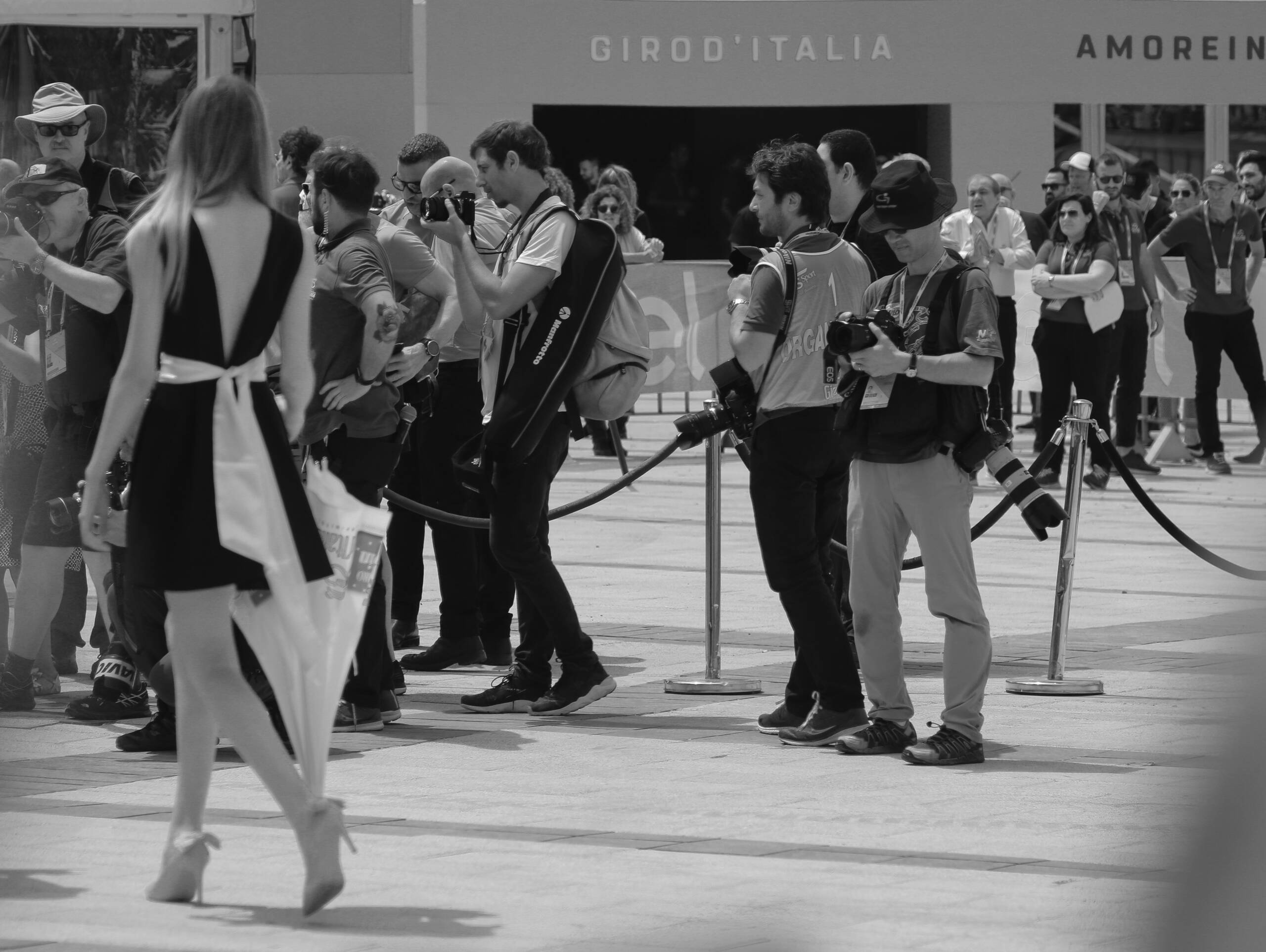
The wall behind them carries GIRO D’ITALIA in spaced capitals, pale on pale, with a black doorway punched under it and a second word running off the right edge of the frame before it finishes. Chrome stanchions with a heavy black rope divide the paving from lower right to centre left, and behind the rope stands a second crowd: staff and guests in sunglasses and lanyards, arms folded, waiting for something that has not happened yet. One man in a panama hat at the far left has his own camera half raised. Another in a bucket hat is checking the back of a body. The shadows are short and hard on the stone, so this is the middle of the day.
She walks the foreground left to right, mid stride, long hair loose. The dress is halter cut, open to the waist at the back, with a wide sash tied in a bow at the small of her spine and a black and white panel falling to the calf. Pale heels. A canvas tote in one hand and a folded umbrella in the other. She is slightly soft, because the plane of focus sits back on the photographers, which is the whole joke of the picture: the camera that made this frame was also set for the pack.
She crosses the entire width of the square and appears in nobody’s take.
That is not a failure of attention. It is the system working exactly as designed.
A press pack looks like a crowd of individuals with cameras. It behaves like a machine with three filters bolted in front of the lens, and all three are set before anyone arrives.
Accreditation is the first edit
The pictures that come out of a major event are determined weeks earlier, in a spreadsheet, by someone who has never held a camera. The organizer issues a finite number of credentials. Wire agencies get theirs automatically because the event needs global distribution. National dailies get theirs because the event needs domestic coverage. Specialist cycling titles get theirs because the sport’s own audience is the sponsorship case. Everyone else gets a rejection or a spectator ticket.
That allocation is an editorial decision disguised as a logistics decision. It fixes, in advance, whose eye will be in the room. A pool assembled from wires, national papers, and trade press will produce wire, national, and trade pictures. It cannot produce anything else, because nobody with a different reason to be there was let in.
The tabard makes this visible. The number on the vest is not identification for the reader. It is identification for the marshals, so the organizer can remove you from a position if you use it wrong.
Position is the second
Once inside, the photographer does not choose where to stand. The rope decides. The stanchions in that square were placed by someone with a diagram, and the diagram exists to guarantee a specific set of frames: the line, the podium, the jersey, the sponsor board behind the jersey.
Anyone who has worked a finish knows the geometry is fixed to within a metre or two. Which is why coverage of the same stage across twenty outlets looks like twenty prints of one negative. The variation is in the crop and the moment, not the vantage. A pool position is a promise that you will get the required picture and a guarantee that you will get nothing else.
The rope has a second function that gets less discussion. It defines an inside and an outside, and it trains the people inside to treat the outside as background. Spectators, staff, passers by, the city itself: all of that is set dressing to be kept out of the frame or blurred behind it. The woman in the photograph is not merely unphotographed. She is on the side of the rope that the pack has been conditioned to subtract.
The shot list is the third
The third filter is the deadline. A wire shooter at a stage finish is filing within minutes, sometimes seconds, often from a laptop on the floor of a media tent or from a card reader on the bike. The pictures have to be captioned with correct rider names, team names, and placings before they move. That requirement does more to shape the take than any aesthetic preference.
A frame with an unidentified person in it cannot be captioned. A frame with no rider in it has no news value to a sports desk. A frame that is interesting but unassignable takes longer to file than it is worth. So the shooter, working at speed against a picture editor who has already told him what is needed, does not make it. Not because he cannot see it. Because there is nowhere to send it.
Every professional pool is optimized for retrieval. The picture desk needs to find the image by rider, by stage, by minute. Anything that does not sort into those bins is friction.
The blind spot is structural
Put the three filters together and the shape of what a press pack misses becomes predictable rather than random.
It misses everything behind the shooter. It misses everything with no name attached. It misses everything that arrives outside the scheduled window, because the pack is looking at the arch when the interesting thing happens in the square. It misses the event’s relationship to the place it is happening in, because the accreditation was for the race, not for the city the race is parked in. And it misses anything that would take more than a caption line to explain.
This is worth stating plainly to anyone who commissions coverage: buying pool access buys you the picture everyone else has. The credential is not an advantage. It is a subscription to a shared output.
What the system gives away
The corollary is the useful part. If the pack’s blind spot is structural, it is also mappable, and anything inside it is available to whoever bothers to stand somewhere else.
That is the whole economics of the unaccredited frame. No lanyard, no assigned position, no filing deadline, no caption requirement, and therefore no constraint on subject. The trade is real: no access to the line, no podium, no rider portraits, nothing the desks are actually paying for that day. What you get instead is everything the desks were never going to ask for, which is most of what the day looked like.
Media organizations have been slow to price this. They still treat accreditation as the asset and the picture as the output. The Giro will generate several thousand near identical images of a finish. It will generate one of a woman in a monochrome dress walking past nine cameras that are all facing the wrong way, and the person who made it was, by definition, not in the pool.
She crossed in front of forty thousand euros of glass and appeared in none of their files.