Manufactured for the Lens: How Product Stunts Buy Earned Media Cheaper Than Ads
A snowmobile sits on a pile of trucked-in snow in the middle of an Austrian shopping street. It is not going anywhere. A rider poses on it, a rope line keeps the public back, and behind that rope a dozen photographers and two video crews work the same three angles for twenty minutes. Nobody is selling a snowmobile to anybody standing there. The machine is a prop, the snow is set dressing, and the actual product being manufactured is a photograph.
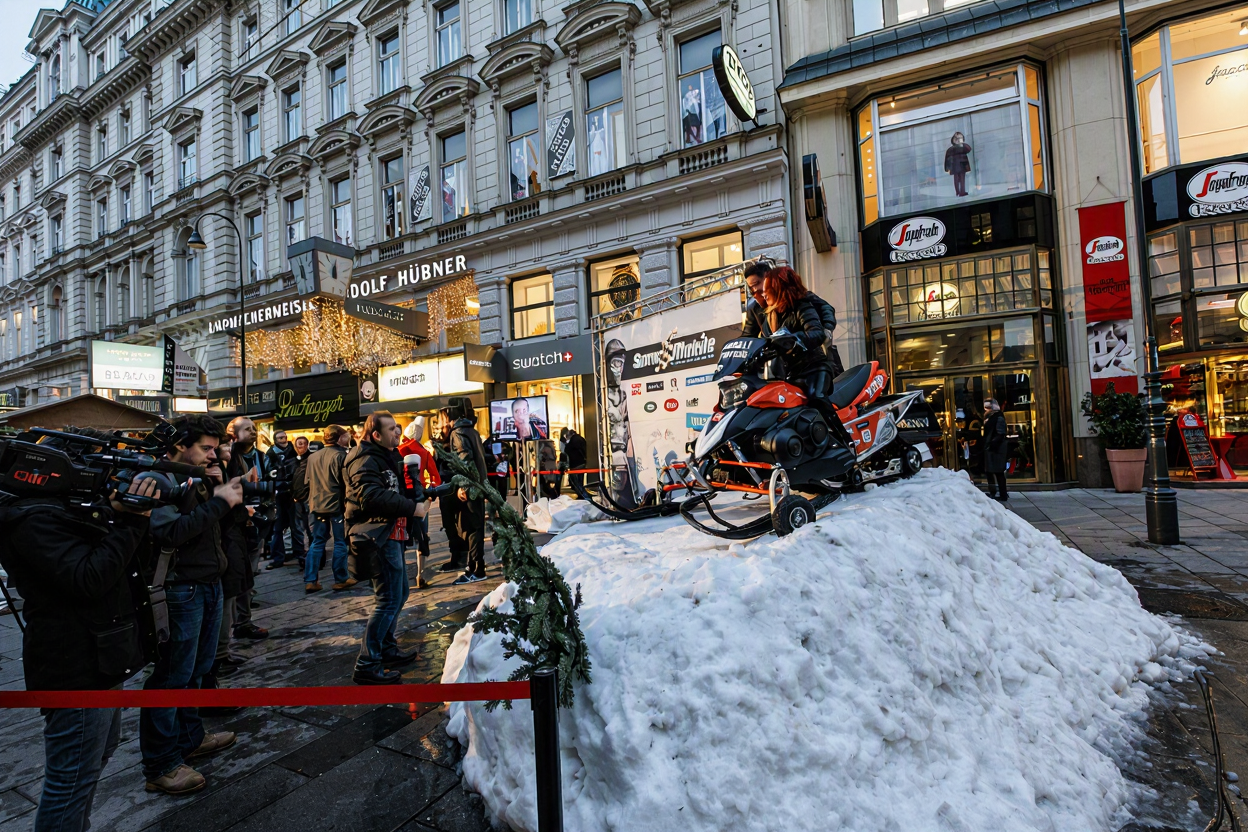
This is the oldest trick in commercial promotion and it survives because the arithmetic still works. A brand that wants attention has two ways to get it. It can buy inventory, in which case it pays a rate card and controls every pixel. Or it can create an event newsworthy enough that other people photograph it for free, in which case it pays for the staging and gives up control of the caption. The second route is cheaper per impression by a wide margin, which is why it keeps happening long after anyone stopped finding it novel.
The Unit Being Bought
Look at what the staging actually optimises for. The backdrop carrying the sponsor logos is positioned directly behind the machine at roughly the height of a standing photographer’s frame, which means a tight shot of the rider includes the branding and a wide shot includes it too. Cropping it out requires deliberate effort. The rope line sits far enough back that everyone shoots from a similar distance, so the frames come out consistent, which makes them easy for a picture desk to run without thinking about it.
The event is not built for the crowd on the street. It is built for a rectangle. Everything inside that rectangle is inventory the brand controls, and it costs nothing per placement once it exists.
Wire agencies are the multiplier. A single accredited agency photographer files a set to Getty, APA, or Reuters within the hour, and from there the image is available to every outlet with a subscription. A local paper in another country picks it up as seasonal filler. A trade title uses it to illustrate a piece about the powersports market. None of those outlets attended, none of them paid the brand, and all of them ran the logo.
The Arithmetic
The cost side of a stunt like this is real but bounded. Snow logistics, refrigerated transport, a street permit, barriers, security, the machine itself, a recognisable face on the seat, and the agency fee for organising it. It lands in the range of a modest regional campaign.
The return is where the industry gets sloppy. Public relations firms report these results as earned media value, calculated by measuring the coverage generated and multiplying it by what the equivalent ad space would have cost, often with a further multiplier applied on the theory that editorial placement is more credible than advertising. The multipliers are invented. Different agencies use different ones, the same agency uses different ones for different clients, and nobody publishes a methodology that survives scrutiny. Treat any earned media value figure as a sales document rather than a measurement.
What can be said without inventing numbers: the coverage is real, the distribution is genuinely wide, and the cost per resulting impression comes in well under display rates. That gap is the whole business model. It is also shrinking, for reasons below.
Why Picture Desks Play Along
Editors are not being fooled. They know exactly what they are being handed. They run it anyway because the incentives point that way.
Picture desks are thinner than they were, and seasonal art is a permanent requirement. A winter feature needs a winter image. A staged event provides one that is well lit, correctly exposed, legally clear, and available at no cost, with a caption already written. The alternative is sending a photographer out to find something, which costs money the desk does not have.
Television is easier still. A visually strange thing in a public place is a forty-second package that fills a gap in a slow news evening. The crews in this frame are there because the assignment desk needed something moving and something odd, and a snowmobile in a shopping street is both.
The brand and the outlet are not adversaries here. They are trading. The outlet gets cheap content, the brand gets distribution, and the reader gets a picture of a snowmobile parked where a snowmobile does not belong.
Where It Breaks
Three things have eroded this model.
The first is caption risk. The brand controls the frame but not the words attached to it. A stunt staged during a bad news week for the company becomes an illustration for the bad news. Every activation carries that exposure, and it is unpriced.
The second is the collapse of the intermediary. The wire-to-outlet pipeline that made this efficient is weaker every year, as picture desks shrink and outlets close. The same brand can now seed images directly to creators and post them itself, which is faster, cheaper, and fully controlled. That looks like a win, but it is a different product. Self-published images carry no third-party credibility, which was the entire justification for the multiplier the agencies were applying.
The third is measurement. Marketing budgets have moved toward channels that report attributable conversions. A street activation reports coverage, and coverage is not a conversion. In a procurement review it loses to a channel that can show a chain from impression to sale, whether or not that chain is honest.
None of this has killed the format. Events like this still run every winter, because the frames still get used and the cost still comes in low. What has changed is the honesty of the accounting around them. The stunt was always a way of buying attention at a discount by getting other people to distribute it. It just used to come with a spreadsheet claiming it was something more.
The snow melts by Thursday. The photographs do not.