ZTE Status Report 2026: Record Revenue, Halved Profit, and a Permanent Exit From Western Networks
The photograph is CeBIT, Hanover, 2015. A suspended ring of blue neon the size of a small building, two levels of stand, screens promising to depict the future of a city with technologies, and a crowd thick enough that people are shuffling rather than walking. This was ZTE at full extension: a Chinese vendor buying floor space in Germany at the scale of a national pavilion, on the assumption that it would be selling infrastructure to European carriers for the next twenty years.
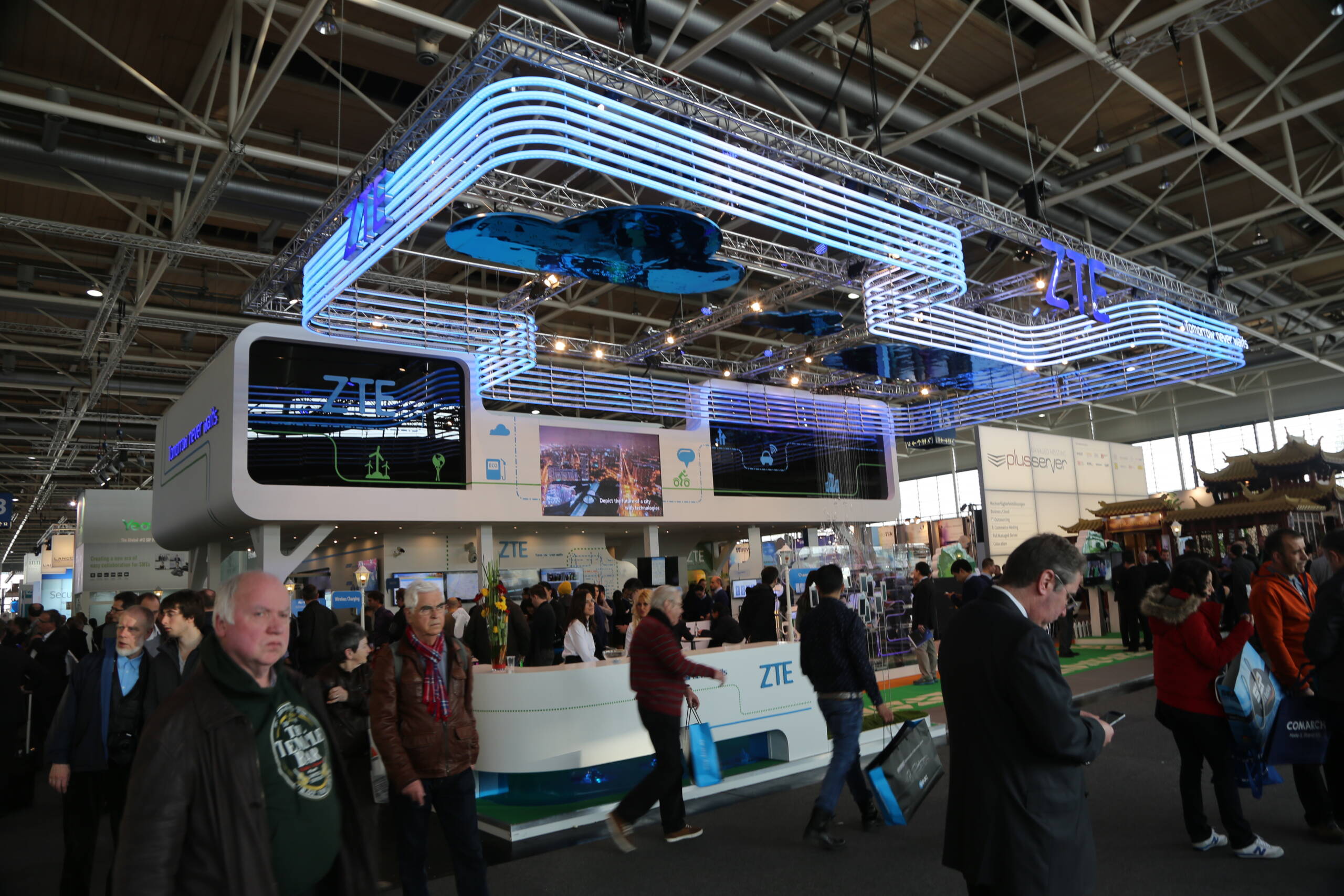
Neither the assumption nor the venue survived. CeBIT was cancelled in 2018, killed by the same trade-show decline that hollowed out most general IT expos; the European carrier business went in the same year, for entirely different reasons.
The eighteen months that reset the company
The sequence is worth restating, because people remember the fine and forget the shutdown.
In March 2016 the Commerce Department put ZTE on the Entity List over re-exports of American components to Iran and North Korea. In March 2017 the company pleaded guilty and agreed to pay $1.19 billion, at the time the largest penalty in the history of US export-control enforcement. That should have closed it. Instead, in April 2018, BIS found ZTE had lied about disciplining the executives involved, and issued a seven-year denial order cutting the company off from anything subject to American export rules.
ZTE stopped functioning within weeks. Not slowed, stopped: main operations suspended, factories idle, a firm with 75,000 employees discovering that its handsets and its base stations both ran on parts it could no longer legally buy. The order came off that July after a $1 billion payment, another $400 million in escrow, the removal of the board and senior management, and the installation of an American compliance monitor who watched the company from the inside until a Texas federal judge ended the supervision term in 2022.
Everything since follows from those weeks. A company that has been switched off once builds differently afterwards.
Where the business actually is now
The first half of 2026 produced record revenue of RMB 78.03 billion, up 9% year on year. Net profit attributable to shareholders was RMB 2.75 billion, down about 46%. Gross margin fell to roughly 25.5%, down close to seven points. Operating cash flow was slightly negative, against RMB 1.3 billion positive a year earlier.
That combination tells you what kind of company this now is.
Computing revenue grew more than 55% and now accounts for 35.1% of the total, with server and storage up nearly 60% and data-centre solutions up over 90%. Government and enterprise revenue jumped 43.5%. The operator network business, historically the whole point of ZTE, is still the largest single segment at 40.7%, and it is the segment that shrank domestically as Chinese carriers cut infrastructure spending after the 5G build.
So ZTE is growing by selling AI compute hardware into Chinese state and enterprise demand, and doing it at margins far below what carrier radio equipment used to earn. Revenue records and a halved profit are the same fact, seen from two ends. R&D stayed at RMB 10.93 billion, 14% of revenue, which is a serious number and the main reason to take the pivot seriously rather than treat it as box-shifting.
The international recovery is real, and it is not Europe
International revenue rose 33.1% to RMB 27.87 billion, now 35.7% of the total. That is the headline number that gets misread.
It is not a return to Hanover. The growth comes from 5G and fibre rollouts in markets that never banned ZTE, from AI infrastructure demand outside China, and from following Chinese enterprises into the countries where they operate. Roughly a third of the business is now export, sold largely to buyers who were never going to be persuaded by a stand at a German trade fair, and who are indifferent to the FCC.
In the United States the position is closed and getting more so. ZTE remains on the FCC Covered List. In June 2026 the Commission moved to prohibit continued importation and marketing of equipment added to that list in 2024 or earlier, and it has spent the past year expanding the list by product origin rather than by company name: drones in December 2025, consumer routers in March 2026, power inverters and advanced robotics in July. The regulatory logic has shifted from naming ZTE to naming categories, which means the door is not being closed against a firm that could argue its way back in. It is being welded on a class of goods.
Western Europe is quieter about it and has arrived in much the same place, with Chinese vendors squeezed out of core network positions by national security rules that mostly avoid saying so directly.
What the 2015 photograph was actually claiming
Look at the stand again. The money spent on that structure only makes sense as an argument: we are a peer of Ericsson and Nokia, we intend to sell to Deutsche Telekom and Orange and Vodafone, and we will be here every year until you believe it.
That argument lost, and it lost on grounds that had nothing to do with the product. ZTE’s kit was competitive and cheap; the reason it is not in European cores has to do with jurisdiction, not performance. Whatever you think about the security case, the outcome is that the market for telecom infrastructure split into two, and the company now competes on one side of the line only.
Which is survivable, and ZTE has survived. Annual revenue was roughly RMB 100 billion in 2015 and RMB 133.9 billion in 2025. A decade of work for about a third more revenue, with the profit engine replaced by a lower-margin one. Compare that with what the same decade did for its Western rivals, or for anyone selling AI hardware, and the cost of the detour becomes legible.
What to watch
Three things decide the next two years. Whether computing margins improve as the mix matures, or whether ZTE has traded a good business for a big one. Whether domestic carrier capex turns before 6G. And whether the origin-based rulemaking now running through Washington starts reaching the categories where ZTE’s growth actually sits, because a company selling servers and data-centre gear is exposed to a very different list than a company selling base stations.
The blue neon came down in 2015 and went into storage. It never went back up in Germany.