Casa da Índia in Lisbon: What a Chiado Charcoal Grill Gets Right About Simple Food
You smell it before you find it. Walk up Rua do Loreto from Praça Luís de Camões and somewhere around number 49 the air turns to smoke and chicken fat, and there is the grill, sitting right in the window, glass smeared with grease and the cook’s back to the street.
That window is the whole argument. Casa da Índia does not hide the kitchen behind a swing door. The fire is the shopfront. Spatchcocked chickens, pork, fish, all of it laid straight over glowing charcoal at eye level while people queue on the pavement outside and watch dinner happen.
Charcoal is the recipe
There is no technique here that a home cook could not name. Bird split flat, salted, put over coals, turned, brushed, turned again. What you cannot copy at home is the fire. It has been burning since noon, it is deep, and the bars sit close enough to the embers that the skin blisters before the meat dries out.
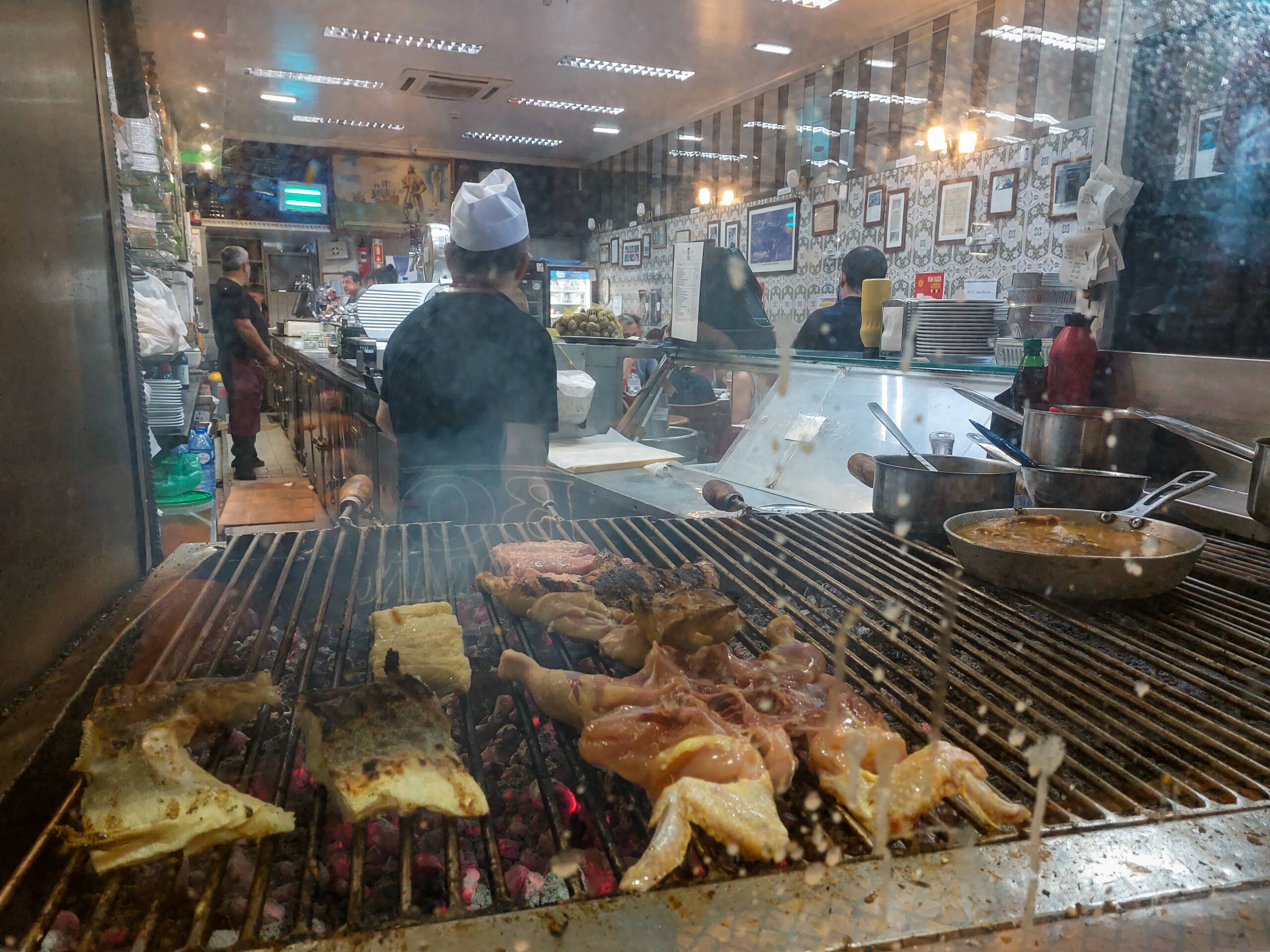
Gas would be easier. Gas would also be pointless. The reason a Portuguese frango tastes like nothing you make on a Weber is that the fat drips, catches, and comes back up as smoke, over and over, for hours, into everything on the grate. The grill is seasoned the way a pan is seasoned.
Piri-piri arrives separately, in a little jug, and that matters too. It is not a marinade doing the work in advance. It is chilli steeped in oil, poured over at the end, sharp and hot and slightly raw against the smoke.
The menu is a list
Chicken. Sardines when they are in. Dourada. Squid. Pork. Octopus salad. Chips, rice, a plate of tomato and onion. Bread and cheese land on the table whether you asked or not, and you pay for what you eat.
Nothing on that list is a dish in the modern sense. There is no plating, no reduction, no chef’s idea sitting between you and the fish. The kitchen buys well, salts properly, and gets out of the way. When it works, and it usually works, you get the thing itself: sardine skin crisp and salty, the flesh underneath still just barely set.
That is a harder trick than it sounds. Simple food has nowhere to hide. Overcook the dourada and there is no sauce to rescue it.
The room is part of the cooking
It is loud. It is narrow. You will sit at a counter or share a table with strangers, elbows in, waiters moving plates over your head at speed. Tiles on the walls, framed clippings, stacks of plates, a spike full of receipts by the till.
None of this is designed. Nobody hired anyone to make it feel authentic, which is exactly why it does. The place looks the way it does because it has been feeding people quickly and cheaply for a long time and never had a reason to stop.
The service moves at the same tempo. Order fast, eat, pay, leave, and someone is already in your chair. That rhythm keeps the prices where they are.
What it costs and when to go
Two people can eat properly, with wine, for the price of one main course in the restaurants two streets uphill. Portions are generous enough that ordering three things between two of you is usually a mistake.
It runs late, past midnight most nights, and it closes on Sundays. There is almost always a queue at eight, less of one at six or after eleven. Bring cash and do not expect anyone to be charmed by a long conversation about the wine list. The house red comes in a jug and it is fine.
Lisbon has plenty of restaurants now with tasting menus and ceramics from a studio in Alentejo. Some of them are very good. But if you want to understand why Portuguese food travels so badly and tastes so well at home, stand outside that window on Rua do Loreto for five minutes and watch the coals.
Then go in and order the chicken.
Sources: Travel Marketing, Sharp Knife, Peppers, Virtual Travel Guide