NAB 2026: Las Vegas and the End of the Broadcast Era
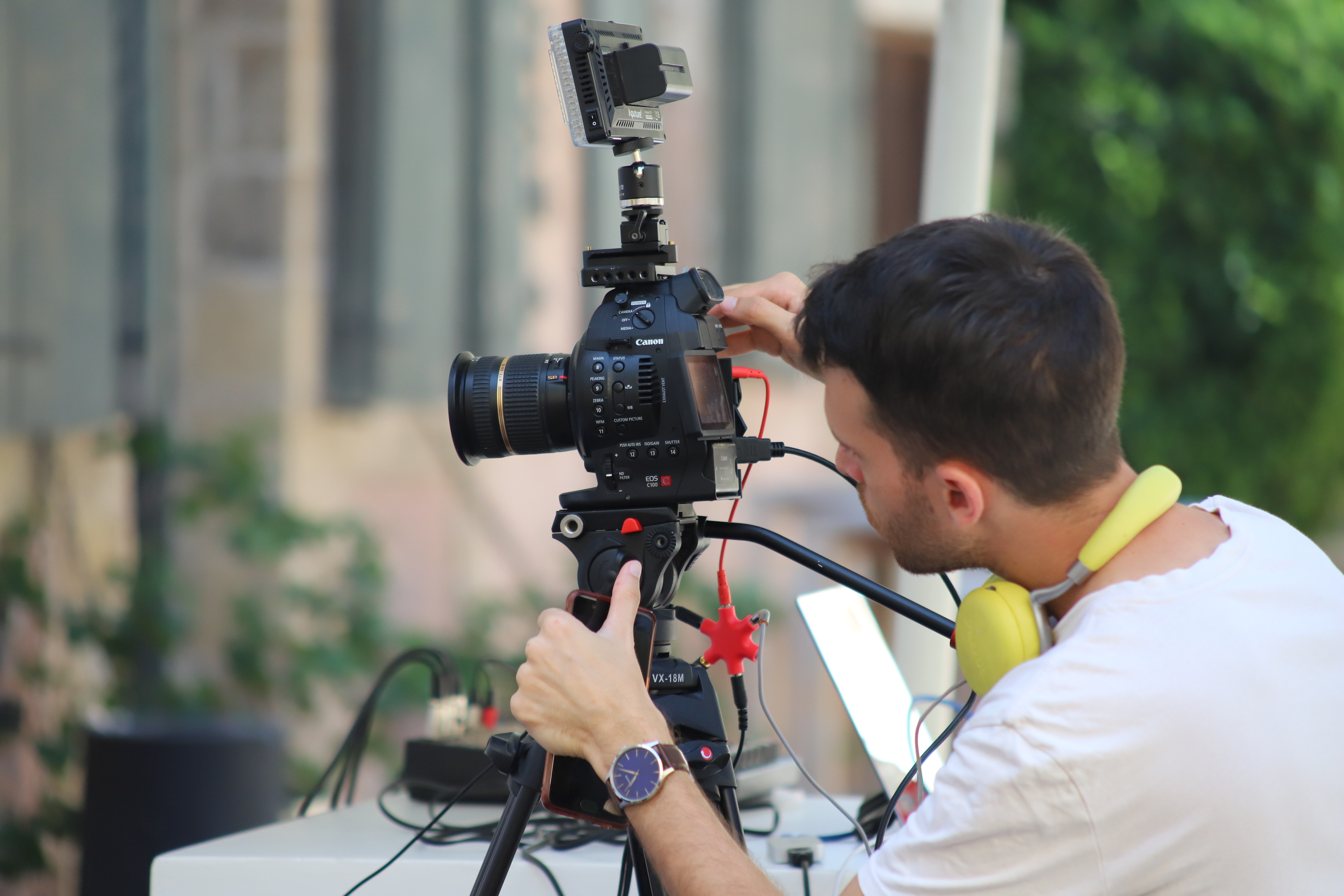
The Canon EOS C300 in the photograph is not new. The operator working it — yellow headphones around his neck, red XLR cable snaking toward an unseen mixer, a fluid head locked down in the afternoon heat — is running gear that belongs to a previous generation of the cinema camera conversation. At NAB 2026, that conversation moved several steps forward without him. It may have moved past the show entirely.
The 2026 NAB Show wrapped on April 22 at the Las Vegas Convention Center with more than 58,000 registered attendees and representation from over 18,000 companies, a significant jump from 12,000 companies in 2025. The headline figure is not the attendance. It is the composition. Broadcasters still occupy the halls, but they are outnumbered now by the accumulated weight of streaming engineers, AI platform architects, sports media executives, and creators whose entire production infrastructure fits inside a backpack. The show’s stated theme — the future of storytelling — is an honest description of the identity crisis it is navigating.
Canon
Canon arrived with the announcement that will dominate lens conversations for the rest of 2026: the CINE-SERVO 40-1200mm T5.0-10.8. The lens extends Canon’s broadcast servo zoom lineage to its logical extreme, covering 40mm through 1200mm with a built-in 1.5x extender that pushes the effective reach to 1800mm. It weighs under 15 pounds at 16 inches in PL mount configuration. It ships in September for $79,999. The target buyer operates at the intersection of wildlife, live sports, and cinematic documentary — contexts where reach and servo precision matter more than maximum aperture. The accompanying Cinema EOS firmware suite, covering the C400, C80, C70, C50, and R5C, ships in summer 2026 and addresses live production reliability and remote operation workflow improvements that operators have been requesting since the C300 generation. Canon’s booth at C3825 drew consistent crowds, evidence that the Cinema EOS platform retains real commercial pull even as its sensor architecture ages relative to newer entrants.
GoPro
The more disruptive camera announcement at NAB 2026 did not come from a traditional cinema brand. GoPro unveiled the MISSION 1 series on Day 1, and the pricing and specification combination is aggressive enough to reframe expectations for compact production cameras. The Mission 1 Pro, priced at $699 and available in late May, carries a 50-megapixel 1-inch sensor and the company’s new GP3 processor. It shoots 8K at 60 frames per second, 4K at 240 frames per second, and 1080p at 960 frames per second. The Mission 1 Pro ILS — same processor, same sensor, same price — adds a Micro Four Thirds mount, making it what GoPro is describing as an ultra-compact mirrorless cinema camera. The entry-level Mission 1 comes in at $599 for 8K at 30fps. For a company that spent much of 2024 and 2025 in a defensive cost-cutting posture, the MISSION series represents a swing at a category that DJI and Blackmagic currently control. Whether the GP3 processor delivers on its image quality claims in real production environments will determine whether GoPro has genuinely broken through or merely spec-sheeted its way into a conversation it cannot sustain.
Blackmagic Design
Blackmagic Design dropped DaVinci Resolve 21 ahead of the show floor opening, and the headline addition is unusual for a company whose identity has been built on motion picture post-production. The new Photo page brings Hollywood-grade color tools to still photography, with native RAW support for Canon, Fujifilm, Nikon, and Sony cameras. Colorists can apply their standard node workflow to still images. Live camera tethering, source-resolution reframing, and album-based media organization round out the feature set. Blackmagic is not the first software company to challenge Adobe Lightroom’s dominance, but it is the first with DaVinci Resolve’s color science underneath. The AI toolset in Resolve 21 adds IntelliSearch for content searching across projects and CineFocus for focal point adjustment. Whether working photographers migrate from tools they have used for a decade is a separate question from whether Blackmagic has the technical credibility to compete. It does.
Sony
Sony anchored its booth around the FX3 II, built on a 24-megapixel stacked sensor with triple base ISO and 6K recording at 120 frames per second with open gate shooting. The FX3 line has carried independent filmmakers since its debut; the FX3 II appears designed to hold that constituency against pressure from Canon’s EOS C50 and Nikon’s Zr. Sony also presented a 2026 Cinema Line firmware roadmap, with FX6 v6.0 having shipped in February with a new quick-access menu system.
The AI Question
Every significant platform company on the show floor in 2026 had AI tools in some stage of demonstration. Akta showed AI-driven media processing that moves from raw footage to publish-ready clips through automated scene detection, metadata extraction, and vertical video reformatting. AWS ran a Cloud Court Challenge featuring AI-powered coaching in the West Hall lobby. The Sports Summit — expanded to four full days for the first time — operated largely on the premise that AI-enhanced fan engagement platforms and low-latency 4K streaming infrastructure are the essential investment categories ahead of the FIFA World Cup and Winter Olympics, both of which land on the 2026 calendar. The convergence of broadcast tools and AI workflow automation is no longer a fringe conversation at NAB. It is the primary conversation.
Audio
RØDE’s RODECaster Video Core generated significant attention in the creator-facing segment of the show. Sennheiser introduced the MKH 8018, a compact broadcast shotgun microphone extending its MKH line. Solid State Logic demonstrated its System T range at booth C6907, including the S500m and S400 consoles running the Virtual Tempest Engine for cloud-native audio processing. Audio is not where the headlines land at NAB, but it is where production infrastructure decisions get made.
The photograph above captures something the show floor cannot fully represent: the operator who is still making work with what he has, building the frame by hand, running red cable from camera to desk in afternoon heat. NAB 2026 catered to him, and also tried to make him obsolete. The industry has been managing that tension for twenty years. What changed in Las Vegas this week is the rate.